Burst Pipes in Winter: What Scottdale Homeowners Need to Know
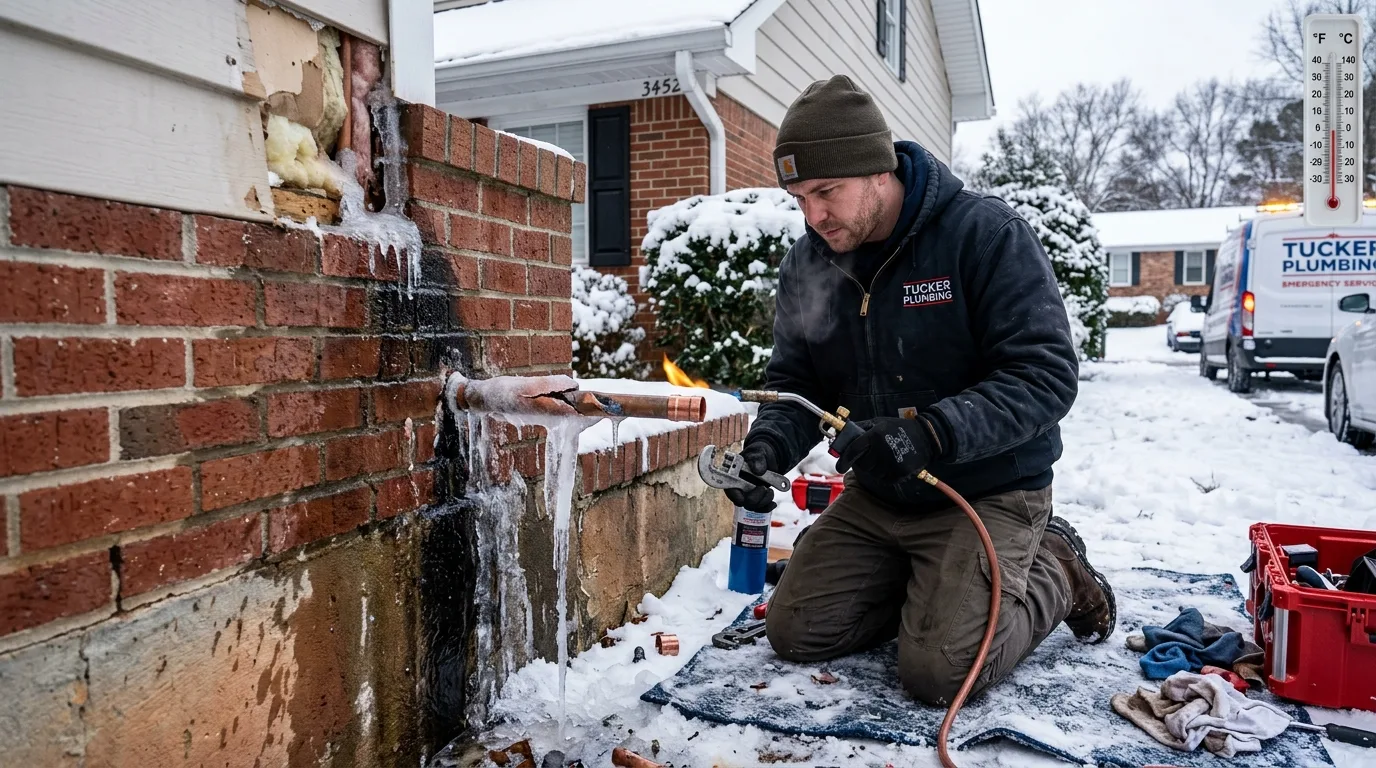
A burst pipe in a Scottdale home follows a predictable and unforgiving sequence: temperatures drop toward the January average low of 35°F, water in an uninsulated pipe section freezes and expands, the pipe wall cracks — and then, when temperatures rise the next morning, the frozen plug thaws and releases the full pressure of the water supply through the crack and into your wall, ceiling, or floor. By the time most homeowners discover the damage, significant water has already spread through the structure.
In this post, we cover why Scottdale pipes are more vulnerable to winter bursts than many homeowners expect, the 30-minute action sequence after discovering a burst, emergency water extraction basics, and prevention steps that can eliminate most burst pipe risk before next winter.
Burst Pipe Emergency in Scottdale?
24/7 emergency water extraction — call (877) 698-1311 for immediate dispatch.
Why Scottdale’s Climate Creates Unexpected Pipe Burst Risk
Most Georgia homeowners think of burst pipes as a problem for cold-climate states. But Scottdale’s freeze-thaw pattern creates a specific risk that is arguably more dangerous than consistently cold winters. In a region where winter temperatures average 35°F at night but regularly climb above 50°F during the day, pipes cycle between frozen and thawed conditions repeatedly during cold snaps rather than remaining continuously frozen. Each freeze-thaw cycle stresses the pipe metal or plastic, and the crack that releases the flood often opens on the third or fourth freeze — not the first.
The other Scottdale-specific factor is construction practice. Homes built for Georgia’s climate — where sustained freezes were historically uncommon — often have plumbing in exterior walls without adequate insulation, supply lines running through unheated crawlspaces, and pipe runs in garage walls that are fully exposed to outside temperatures. These configurations, standard in Scottdale construction from the 1950s through the early 2000s, leave pipes vulnerable to the increasingly severe winter cold snaps that Georgia has experienced in recent years.
Types / Options: Pipe Burst Scenarios by Location
Crawlspace Pipe Bursts: Supply lines running through uninsulated crawlspaces are among the most common burst pipe locations in Scottdale. When temperatures drop, these pipes lose heat rapidly with no interior warmth source to moderate the temperature. Crawlspace pipe bursts often go undetected for hours because the water releases into the crawlspace below the living space — sometimes completely draining the hot water tank before the homeowner notices a pressure change. Emergency plumbing repair followed by water extraction and crawlspace drying is required.
Exterior Wall Pipe Bursts: Pipes in exterior walls without adequate insulation freeze from the outside in during a cold snap. The crack is typically near where the pipe enters or exits the wall assembly. Water releases into the wall cavity and soaks insulation and drywall rapidly — sometimes appearing at ceiling level when the pipe run crosses above a finished space.
Garage Supply Line Bursts: Refrigerator water lines, laundry supply lines, and utility sink connections in attached garages run through spaces that are directly exposed to outdoor temperatures. These are the highest-risk locations during a Scottdale winter cold snap and the most frequently overlooked during winterization.
Attic Supply Line Bursts: Less common but high consequence — pipe runs in attic spaces that serve upper-level bathrooms or ice makers can burst and release significant volumes of water through multiple ceiling cavities before the damage is apparent at the living level.
Practical Uses: Your First 30 Minutes After a Burst Pipe
- Shut off the main water supply immediately: The main shutoff is typically at the water meter or at a shutoff valve inside the home near where the main supply enters. Every homeowner should know this location before an emergency occurs. Stopping the water source is the single most important action in the first 30 minutes.
- Turn off the water heater: If you’ve shut off the main supply, protecting the water heater from running dry prevents a secondary appliance damage event.
- Document with photographs before any cleanup: The first photographs — before anything is moved or dried — are the most important documentation for your insurance claim. Capture the source location, the water spread, and any affected materials.
- Call a 24/7 water extraction service: Do not wait until morning. Emergency water extraction initiated within the first 2 hours dramatically limits the spread of water into adjacent rooms, walls, and subfloor layers.
- Do not use ceiling fans or the HVAC to dry: Running fans and HVAC before the source and contamination category are assessed can spread moisture to unaffected areas of the home and accelerate mold spread in wall cavities.
- Call your insurer: Report the claim as soon as you’ve handled immediate safety steps. Burst pipes from freeze-thaw events are generally covered under standard Georgia homeowner’s policies as sudden and accidental water damage.
How It Works: Water Extraction After a Burst Pipe
Professional water extraction after a burst pipe event in Scottdale begins with a moisture mapping inspection — thermal imaging identifies exactly how far water has traveled inside wall cavities and beneath subfloors before any extraction equipment is deployed. This mapping determines the full scope of the event, which is often significantly larger than the visible surface damage suggests.
Extraction removes standing water and moisture from accessible surfaces. Drying equipment — industrial air movers and commercial dehumidifiers — then begins the structural drying phase, which typically runs 3 to 7 days in Scottdale homes. Daily moisture readings confirm drying progress toward IICRC targets. In crawlspace-involving events, drying timelines extend to 7 to 14 days due to the ambient clay soil moisture that competes with the dehumidification process.
Burst Pipe Water Damage in Scottdale — Act Fast
Every hour of delay increases damage scope. Call (877) 698-1311 for 24/7 emergency extraction.
Cost Factors for Burst Pipe Repair and Restoration in Scottdale
Atlanta metro water damage restoration averages $8,546, with a range of $1,874 to $15,960. Burst pipe events in Scottdale homes tend toward the lower end of the range when the pipe is located, shut off, and extracted within 2 to 4 hours — because the water spread is contained. Events discovered after 12 or more hours, or where the burst occurred in a crawlspace that flooded overnight, trend toward the higher end.
Emergency plumbing repair to replace the burst pipe section is a separate cost from the water damage restoration — typically $200 to $800 for the pipe repair itself, depending on location and accessibility. DeKalb County plumbing permits are required for plumbing repairs performed by a contractor; homeowners can pull their own permits for DIY work. Structural drywall and flooring replacement follows the drying phase and requires additional DeKalb County permits for significant reconstruction.
Frequently Asked Questions
What temperature causes pipes to freeze in Scottdale, GA?
Pipes begin to freeze at sustained temperatures of 20°F or below, but pipe cracking typically occurs during the thaw cycle after a freeze rather than at the lowest temperature. Scottdale pipes in uninsulated crawlspaces and exterior walls are at risk whenever overnight temperatures fall below 28°F for more than 4 to 6 hours. The January average low of 35°F is close enough to the freeze threshold that any colder-than-average night creates real risk.
How do I prevent pipe bursts in my Scottdale home this winter?
Insulate exposed pipes in crawlspaces and unheated spaces with pipe wrap rated for the expected temperature range. During cold snaps below 28°F, allow a slow drip from faucets served by exterior wall pipes — moving water is harder to freeze. Know the location of your main shutoff valve. Have your crawlspace inspected for inadequately insulated supply lines. These steps eliminate the majority of burst pipe risk in Scottdale homes. For the full prevention protocol, see our hidden water damage prevention guide for Scottdale homeowners.
Is burst pipe water damage covered by my insurance in Georgia?
Yes — freeze-thaw burst pipe damage is one of the most clearly covered events under standard Georgia homeowner’s insurance policies. It qualifies as sudden and accidental water damage. File your claim promptly, document thoroughly before cleanup, and have your restoration contractor present for the adjuster’s inspection. See our DeKalb County insurance claim filing guide for the complete process. For restoration services, see our emergency water extraction service page.
Burst Pipe Damage Restored — Start to Finish
Scottdale Water Damage handles extraction, drying, plumbing coordination, and reconstruction. Call (877) 698-1311.
Related: