How to Choose a Water Damage Restoration Company in Scottdale
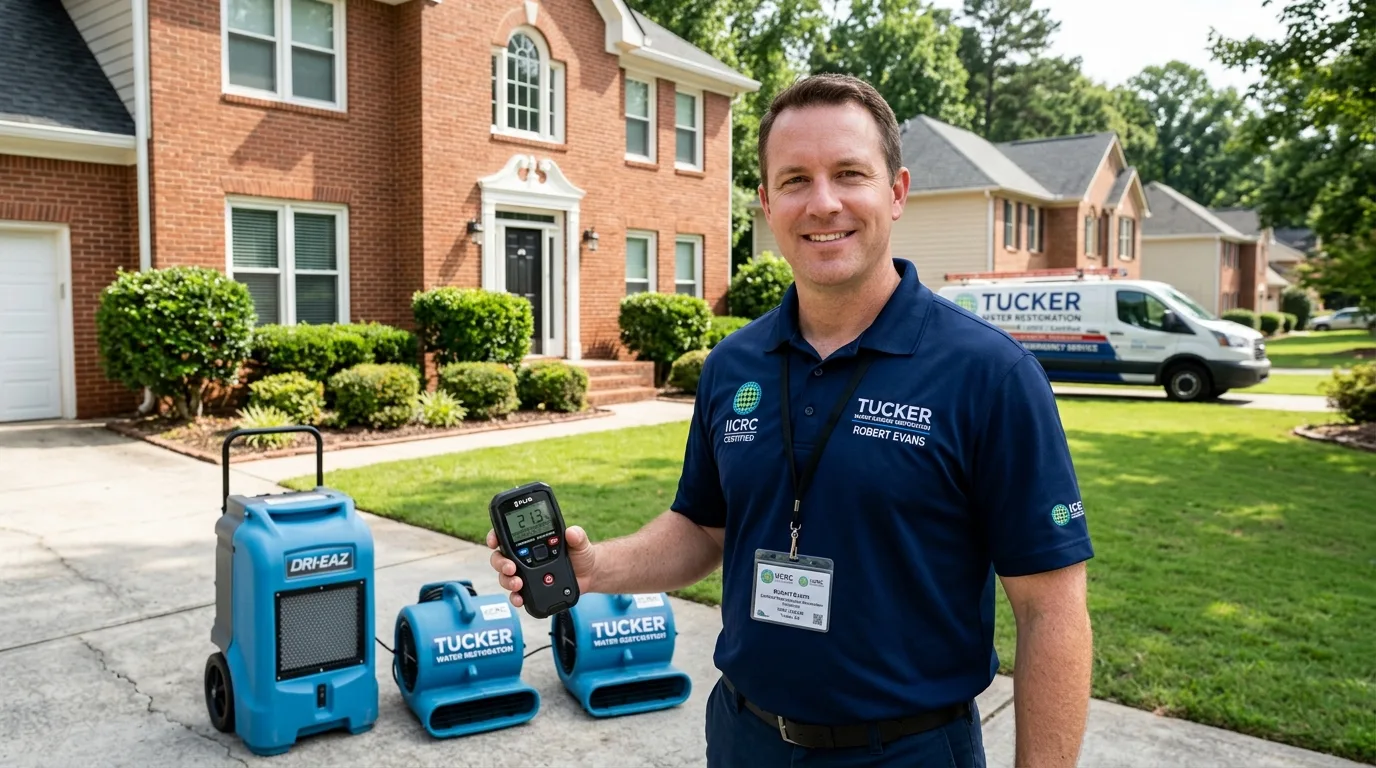
The right water damage restoration company in Scottdale returns your home to pre-loss condition, documents everything your insurer needs, and charges you a fair rate for work that genuinely addresses the cause — not just the visible symptoms. The wrong company takes your money, leaves structural moisture behind, misses the crawlspace, and has you calling a mold remediation company six weeks later. Knowing the difference before you call anyone is the most financially important thing a Scottdale homeowner can do.
In this post, we cover the five verification steps that separate qualified restoration contractors from inadequate ones, what local experience in DeKalb County’s soil and climate environment actually means, how to evaluate insurance documentation capability, and the questions that reveal a contractor’s real qualifications within the first two minutes of a call.
Talk to Scottdale's Certified Restoration Team
IICRC certified, insurance assistance, 24/7 response. Call (877) 698-1311 for a free assessment.
Why Choosing Correctly Matters More in Scottdale
Scottdale’s humid subtropical climate and Piedmont red clay soil create a technical environment that punishes mediocre restoration work more severely than drier, better-draining regions. A contractor who stops drying too early — leaving 15% moisture content in wall framing when the IICRC target is 12% — might escape consequence in Phoenix. In Scottdale, where ambient summer humidity exceeds 70% and clay soil keeps crawlspace humidity elevated year-round, that 3% gap is enough for mold colonization to begin within days of the contractor’s departure.
This means the stakes in Scottdale for choosing incorrectly are higher than average. Inadequate drying in this climate reliably produces mold remediation as a second project — adding $2,664 to $8,437 to a restoration that would have cost significantly less if done correctly the first time. Local climate knowledge is not a marketing claim — it is a technical prerequisite for outcomes that hold.
Types / Options: Contractor Categories in the Scottdale Market
National Franchise Brands: SERVPRO, ServiceMaster, PuroClean, and similar franchises provide the benefit of national-standard training and brand accountability. Local franchise quality varies significantly by owner; the franchise’s national reputation does not guarantee local execution quality. Ask specifically about the local franchise’s IICRC certifications, staffing, and equipment — not the national brand’s.
Local Independent Firms: Local restoration contractors range from highly qualified IICRC-certified operations to unlicensed operators with minimal equipment and no formal training. The local independent option is not inherently better or worse than a franchise — the individual firm’s qualifications are what matter.
General Contractors Offering Restoration: GCs who add water damage response to their service list often lack IICRC-certified technicians, proper moisture measurement equipment, and the drying protocols that distinguish restoration from basic cleanup. Using a GC for water damage restoration is a common source of the failed-drying outcomes that produce subsequent mold remediation needs.
Mitigation-Only vs. Full-Service Contractors: Some restoration companies perform only the mitigation phase (extraction and drying) and hand off reconstruction to a separate GC. Others — including Scottdale Water Damage — manage both phases under one contract. The full-service approach provides accountability across the entire project and simplifies insurance claim coordination.
Practical Uses: Five Verification Steps Before You Hire
- Verify IICRC certification: Ask for the technician’s IICRC certification number and verify it at the IICRC’s online registry (iicrc.org). WRT (Water Damage Restoration Technician) and ASD (Applied Structural Drying) are the relevant certifications for water damage work. Any contractor who cannot provide verifiable certification numbers should be disqualified.
- Ask about moisture documentation: Require a written commitment that daily moisture readings will be documented throughout the drying process and provided to you at project completion. A contractor who will not commit to this in advance will not be performing it during the project.
- Confirm post-remediation verification if mold is involved: For any project where mold remediation is required, require written post-remediation air sampling and surface testing results before accepting project completion. This is the only objective evidence that the remediation was successful.
- Verify insurance and licensing: Request a certificate of general liability insurance and workers’ compensation coverage before any work begins. In Georgia, confirm that the contractor or their licensed subcontractors hold current state trade licenses for any plumbing or electrical work in the project scope.
- Request Georgia-specific references: Ask for references from water damage restoration projects specifically in the DeKalb County area — Scottdale, Decatur, Clarkston, Tucker, or Stone Mountain. Local references confirm familiarity with the clay soil conditions, permit requirements, and insurance adjuster relationships specific to this market.
How It Works: Evaluating a Contractor in Two Minutes
The fastest way to evaluate a restoration contractor’s qualifications is to ask these four questions when they answer the phone:
1) What IICRC certifications do your technicians hold? A qualified contractor answers immediately with specific certifications (WRT, ASD, AMRT for mold). An unqualified contractor gives a vague answer or asks you to look at their website.
2) Will you provide written daily moisture readings throughout the drying process? A qualified contractor says yes and describes their monitoring protocol. An unqualified contractor says “we’ll make sure it dries” or “our equipment does the work.”
3) Do you assist with insurance documentation and adjuster coordination? A qualified contractor has a documented process for this and can describe it. An unqualified contractor treats the insurance claim as your responsibility.
4) What is your experience with crawlspace flooding in DeKalb County’s clay soil environment? A contractor with local experience gives a specific, knowledgeable answer about clay soil moisture, extended drying timelines, and crawlspace encapsulation. A contractor without local experience gives a generic answer or pivots to equipment capabilities.
Ask Us These Questions Right Now
We answer every question with specifics — not marketing language. Call (877) 698-1311.
Cost Factors: What You’re Actually Paying For
Water damage restoration in the Atlanta metro area averages $8,546, with a range of $1,874 to $15,960. The lowest-price offer is almost never the lowest total cost — contractors who undercut market pricing on extraction and drying typically compensate by cutting corners on drying duration, equipment density, or monitoring frequency. The cost of the resulting mold remediation and reconstruction callback exceeds the savings on the original project in nearly every case.
Across DeKalb County, experienced homeowners who have been through water damage events consistently report that the most cost-effective decision they made was choosing a contractor who provided comprehensive moisture documentation and stayed on the project until IICRC targets were met — rather than the contractor who gave them the lowest initial quote. Labor at $155 to $444 per hour applies to qualified technicians performing documented, protocol-driven work. What that labor buys is fundamentally different between a qualified IICRC contractor and an unlicensed operator — and the difference shows up weeks later, not on day one.
Frequently Asked Questions
How do I know if a Scottdale restoration contractor is actually IICRC certified?
The IICRC maintains a public online registry at iicrc.org where you can search for certified firms and technicians by name, city, or certification type. Search for the contractor name before you hire — the registry shows current certifications and the date they were earned. If the contractor appears in the registry with current certifications in WRT and ASD (and AMRT if mold is involved), their IICRC credentials are legitimate.
Should I hire the company my insurance adjuster recommends?
Insurance adjusters sometimes recommend preferred vendors — contractors with whom the insurer has volume relationships. These contractors are not necessarily the best option for your specific situation; they are contractors the insurer works with regularly. You have the right to choose your own contractor in Georgia, and that contractor must be paid by the insurer at the approved rate as long as their scope documentation meets the adjuster’s requirements. A strong, independently chosen contractor with good documentation capability often achieves better claim outcomes than a preferred vendor with lower documentation standards. See our DeKalb County insurance claim guide for the full process.
Is there a licensing requirement for water damage restoration contractors in Georgia?
Georgia does not have a specific state license category for water damage restoration — it falls under general contracting, which has its own licensing requirements for work above $2,500. However, plumbing and electrical work associated with restoration requires licensed tradespeople. IICRC certification, while not legally required, is the industry standard that provides the most meaningful qualification verification. A contractor who holds current IICRC certifications, carries proper insurance, and uses licensed tradespeople for trade work is your strongest indicator of qualified practice. Read our complete guide to water damage restoration in Scottdale for the full restoration framework.
The Scottdale Team That Checks Every Box
IICRC certified, insured, full documentation, 24/7 response. Call Scottdale Water Damage at (877) 698-1311.
Related: