Water Damage Restoration Scottdale: The Complete Guide
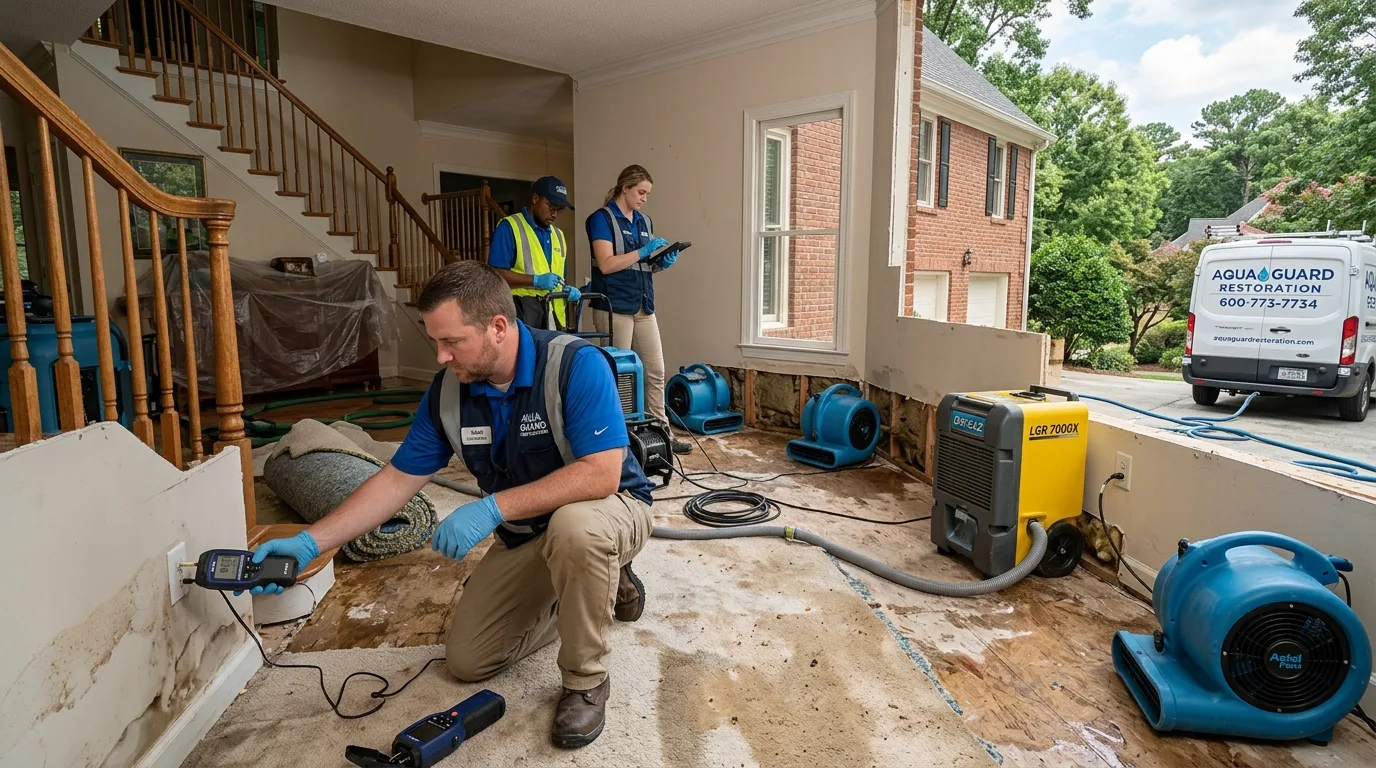
By the time most Scottdale homeowners call a water damage restoration company, they’ve already lost hours — watching water spread across floors, wondering if their insurance covers this, unsure whether to start cleanup themselves or wait. This guide gives you the complete picture: what the restoration process actually involves, what it costs in the Atlanta metro market, and what to look for when hiring a contractor in DeKalb County.
In this post, we cover the IICRC restoration process step by step, cost factors specific to Scottdale, insurance claim basics, and how to vet a restoration contractor before you commit.
Need Emergency Water Extraction in Scottdale?
Call (877) 698-1311 — we're available 24/7 and can dispatch within the hour.
Why Water Damage Restoration Matters for Scottdale Homeowners
Water damage is not a problem that improves with time — it compounds with every passing hour. In Scottdale’s humid subtropical climate, where average summer relative humidity exceeds 70%, the window between water intrusion and mold colonization is just 24 to 48 hours. Homes throughout the Cedar Park neighborhood and the historic Scottdale Mills Village district face this reality after every pipe burst, storm event, or appliance failure.
The IICRC (Institute of Inspection, Cleaning and Restoration Certification) estimates that water damage is the second most common homeowner’s insurance claim in the United States. In Georgia, the peak seasons for claims are spring thunderstorm season (March through May) — when heavy rainfall overwhelms drainage systems across DeKalb County — and winter freeze-thaw cycles in January and February, when temperatures dipping toward the average low of 35°F cause pipe bursts that release significant volumes of water before the homeowner is aware of the failure.
Understanding the restoration process before you need it puts you in control rather than reactive mode when water enters your home.
Types / Options: Water Damage Categories
Category 1 — Clean Water: Originates from a supply line, appliance supply, or rainwater without contamination. This is the least hazardous category and the least expensive to remediate — approximately $7.77 per square foot in the Atlanta metro market. Pipe bursts from supply lines and appliance water line failures are common Category 1 events in Scottdale homes.
Category 2 — Gray Water: Contains some contamination from sources like dishwasher overflow, toilet overflow without solid waste, or rainwater that has contacted surfaces. Requires more aggressive decontamination procedures and removal of porous materials that cannot be effectively cleaned. Costs run approximately $11.66 per square foot.
Category 3 — Black Water: Highly contaminated water from sewage backup, rising floodwater, or water that has been standing long enough to develop microbial contamination. Requires full personal protective equipment, controlled disposal of all porous materials, and thorough antimicrobial treatment. Costs reach approximately $16.65 per square foot. DeKalb County’s aging sewer infrastructure makes sewage backup a real risk, particularly during heavy spring rainfall.
Practical Uses: When Each Phase of Restoration Applies
- Emergency extraction: Required immediately for any standing water — every hour that water remains in contact with structural materials extends the damage depth and scope. Apply immediately regardless of water category.
- Structural drying: Follows extraction and is required even when the space appears visually dry. Moisture meters and thermal imaging reveal saturation in walls and subfloors that is invisible on the surface — and that will develop into mold if left unaddressed in Scottdale’s humid environment.
- Mold remediation: Required when mold colonies have already established — typically when extraction or drying was delayed beyond 48 hours. Also relevant for Scottdale homes with persistent crawlspace moisture from DeKalb County’s red clay soil environment, regardless of a specific flood event.
- Property reconstruction: The final phase — replacing drywall, flooring, cabinetry, and other materials removed during mitigation. Requires DeKalb County permits for structural and plumbing work; handled after structural drying reaches IICRC targets.
- Insurance documentation: Should happen simultaneously with every phase — photographs, moisture readings, and scope documentation compiled from the first moments of the event through final completion.
How the IICRC Restoration Process Works
The IICRC S500 standard describes water damage restoration as a systematic process with documented outcomes at each stage — not a loose collection of cleanup tasks. Here’s what a properly executed restoration project looks like in Scottdale:
Step 1 — Inspection: Thermal imaging cameras identify hidden moisture behind walls and beneath floors. Moisture meters establish baseline saturation levels in structural materials. The water category is determined and the scope of affected areas is mapped and documented. This inspection informs both the equipment plan and the insurance documentation.
Step 2 — Water Extraction: Industrial truck-mounted extractors remove standing water — moving up to 10 times more volume per hour than portable units. Specialty extraction tools address different flooring types: weighted heads for carpet, squeegee tools for hard floors. After bulk extraction, targeted tools reach beneath toe kicks and into confined spaces.
Step 3 — Structural Drying: Industrial air movers and commercial dehumidifiers create a drying system that continuously removes moisture from structural materials and captures evaporated water from the air. Equipment is calibrated to the specific moisture load and adjusted daily based on moisture readings.
Step 4 — Daily Monitoring: Moisture readings are taken at fixed points and documented each day, tracking the drying progress toward IICRC dry targets. Equipment is adjusted based on readings — not removed prematurely because the surface looks dry.
Step 5 — Materials Removal: Structural materials that cannot be dried to target levels — heavily saturated drywall, soaked insulation, contaminated carpet — are removed under controlled conditions and disposed of properly.
Step 6 — Antimicrobial Treatment: EPA-registered antimicrobial agents are applied to remaining structural surfaces after materials removal and drying, as a preventive measure against mold colonization in the period before reconstruction.
Step 7 — Final Verification: A final moisture reading confirms that all structural materials have reached IICRC dry targets. A written report documents the final readings — this is the objective confirmation that drying was successfully completed.
Step 8 — Reconstruction: Drywall, flooring, insulation, and other materials are replaced after DeKalb County permits are obtained. Work is inspected and documented for insurance purposes.
Water Damage in Scottdale? We Handle Every Step.
From emergency extraction to final reconstruction — one call to (877) 698-1311 covers the entire process.
Cost Factors for Water Damage Restoration in Scottdale
Water damage restoration in the Atlanta metro area — which includes Scottdale — averages $8,546, with a typical range of $1,874 to $15,960. Several factors specific to DeKalb County affect where a given project falls in that range:
Water category is the single largest variable. A clean water pipe burst costs far less to remediate than a sewage backup of equivalent volume — because Category 3 events require full PPE, controlled disposal of all porous materials, and more extensive decontamination.
Affected area scales cost directly. A single room at $7.77 per square foot for clean water is a very different project than a flooded basement at $16.65 per square foot for black water.
DeKalb County permit costs add to reconstruction budgets for structural and plumbing work. Permit processing at the county’s One-Stop office at 178 Sams Street, Decatur, adds fees and 5 to 10 business day processing time for permitted scope.
Red clay soil moisture extends drying timelines in Scottdale and across DeKalb County compared to regions with faster-draining soils — because the soil maintains elevated ambient moisture around the structure throughout the drying process, requiring more aggressive dehumidification and longer equipment run times.
Labor runs $155 to $444 per hour depending on the trade and complexity of the work. Mold remediation, if triggered by delayed response or pre-existing crawlspace moisture, adds $2,664 to $8,437 to the project total.
Frequently Asked Questions
How do I know if water damage is covered by my homeowner’s insurance in Georgia?
Most standard homeowner’s insurance policies in Georgia cover sudden and accidental water damage — a pipe burst, an appliance failure, or a roof leak. They typically do not cover flooding from rising groundwater or storm surge, which requires a separate flood insurance policy through NFIP or a private carrier. The critical word is “sudden” — gradually developing leaks that you should have detected and repaired are often denied. Document everything from the moment of discovery and report to your insurer promptly. See our insurance claim guide for DeKalb County homeowners for the full process.
What should I do immediately after discovering water damage in my Scottdale home?
Shut off the water source if accessible and safe to do so. Call your insurance company to report the claim. Call a 24/7 water extraction service immediately — delay is the most costly decision you can make. Do not turn on ceiling fans or run the HVAC until the moisture source is identified and the extent of contamination (water category) is determined. Document everything with photographs before any cleanup begins.
How can I tell if water damage in my Scottdale home has led to mold?
Visible mold (black, green, or white growth on surfaces), a persistent musty odor that doesn’t dissipate, and health symptoms that improve when you leave the property are the primary indicators. However, mold frequently develops in hidden spaces — wall cavities, crawlspaces, and beneath subfloors — where it is not visible without inspection equipment. If a water event was not professionally dried to IICRC moisture targets within 48 hours, a mold inspection is warranted. Read our guide to mold after water damage in Scottdale for signs and next steps.
Start Your Scottdale Restoration Project Today
Scottdale Water Damage provides the full process — extraction, drying, mold remediation, and reconstruction. Call (877) 698-1311.
Related: