Mold After Water Damage: Why Scottdale Homes Are At Risk
Have you ever wondered why a Scottdale neighbor’s water damage — from what seemed like a contained pipe burst — ended up involving mold remediation that cost more than the original cleanup? The answer is almost always the same: the drying phase was incomplete, the ambient conditions in DeKalb County accelerated mold colonization faster than expected, and by the time mold was visible, it had already spread well beyond the originally affected area.
In this post, we cover why mold develops faster in Scottdale than in many other markets, the specific interaction between DeKalb County’s clay soil moisture and mold risk, how to identify mold in its early stages, and what a professional mold remediation process looks like in a Georgia home.
Mold After Water Damage in Scottdale?
IICRC-certified mold remediation — call (877) 698-1311 for a free assessment.
Why Mold Risk Is Higher in Scottdale Than the National Average
The core mold risk factor in Scottdale is not just the water damage event itself — it’s the environment that the event occurs in. Georgia’s humid subtropical climate means that relative humidity in Scottdale regularly exceeds 70% during summer months and stays elevated well above the national average during spring and fall. Mold spores, which are present in every environment, require moisture and warmth to transition from dormant to active growth. In Scottdale’s ambient conditions, that transition happens in 24 to 48 hours after a water intrusion event — significantly faster than the 48 to 72 hours that industry literature references for average conditions.
The clay soil factor compounds this risk in a way that is unique to DeKalb County and the broader Georgia Piedmont region. Piedmont red clay retains moisture against crawlspace walls and foundations for several days after any significant rainfall, maintaining elevated humidity in crawlspace and lower-level spaces even when the rest of the home appears dry. A water damage event in the living space triggers mold risk in the directly affected areas — but the crawlspace beneath the home may already be running at 80%+ relative humidity from soil moisture, making it a secondary mold development zone that many contractors never inspect.
Types / Options: Where Mold Develops After Water Damage
Wall Cavities: The most common and most dangerous post-water-damage mold location. When water enters a wall cavity — from a pipe burst, a roof leak, or lateral intrusion — drywall facing absorbs moisture rapidly. Mold colonizes the paper facing of standard drywall within 24 to 48 hours at Scottdale humidity levels. Visible mold on the wall surface indicates that the colony has been growing inside the cavity for significantly longer.
Subfloor and Floor Joists: Water that reaches flooring often wicks into the subfloor and the floor joist system beneath. In homes over a crawlspace, this creates a direct connection between the living-space moisture event and the crawlspace humidity reservoir. Mold on floor joists is a common finding in Scottdale homes where a kitchen or bathroom water event was cleaned at the surface without addressing the subfloor moisture.
Crawlspace: As noted above, DeKalb County crawlspaces are chronically at elevated mold risk due to clay soil moisture. Homes in the Lantern Ridge community and historic Tobie Grant neighborhood with original crawlspace construction may develop mold in the crawlspace without any discrete water event — simply from the persistent humidity that the surrounding clay soil maintains year-round.
HVAC Ductwork: Air handling equipment that pulls air from a mold-affected space distributes spores throughout the home. HVAC-sourced mold spread is the mechanism by which a localized crawlspace mold colony develops into a whole-home air quality problem. Any mold remediation that does not include HVAC inspection and, where necessary, duct cleaning is incomplete.
Practical Uses: How Mold Remediation Protects Your Scottdale Home
- Air quality verification: Post-remediation air sampling confirms that mold spore counts in the treated areas have returned to normal background levels before the remediation is declared complete. Without this step, there is no objective evidence that the remediation succeeded.
- Structural protection: Mold colonization deteriorates wood framing, subfloor layers, and other organic structural materials over time — an investment in professional remediation protects the structural integrity of your home.
- Health protection: Certain mold species produce mycotoxins that can cause respiratory symptoms, headaches, and other health effects in sensitive occupants. Remediation eliminates the source of ongoing exposure.
- Real estate disclosure: Professionally remediated mold — with written post-remediation verification — can be disclosed in a real estate transaction as a resolved condition. Undisclosed mold discovered during a buyer’s inspection is a deal-stopper and potential legal liability.
- Insurance support: Mold that developed as a result of a covered water damage event is generally included in the insurance claim scope. Dehumidification and mold remediation costs are documented and submitted as part of the water damage restoration claim.
How IICRC Mold Remediation Works in Scottdale
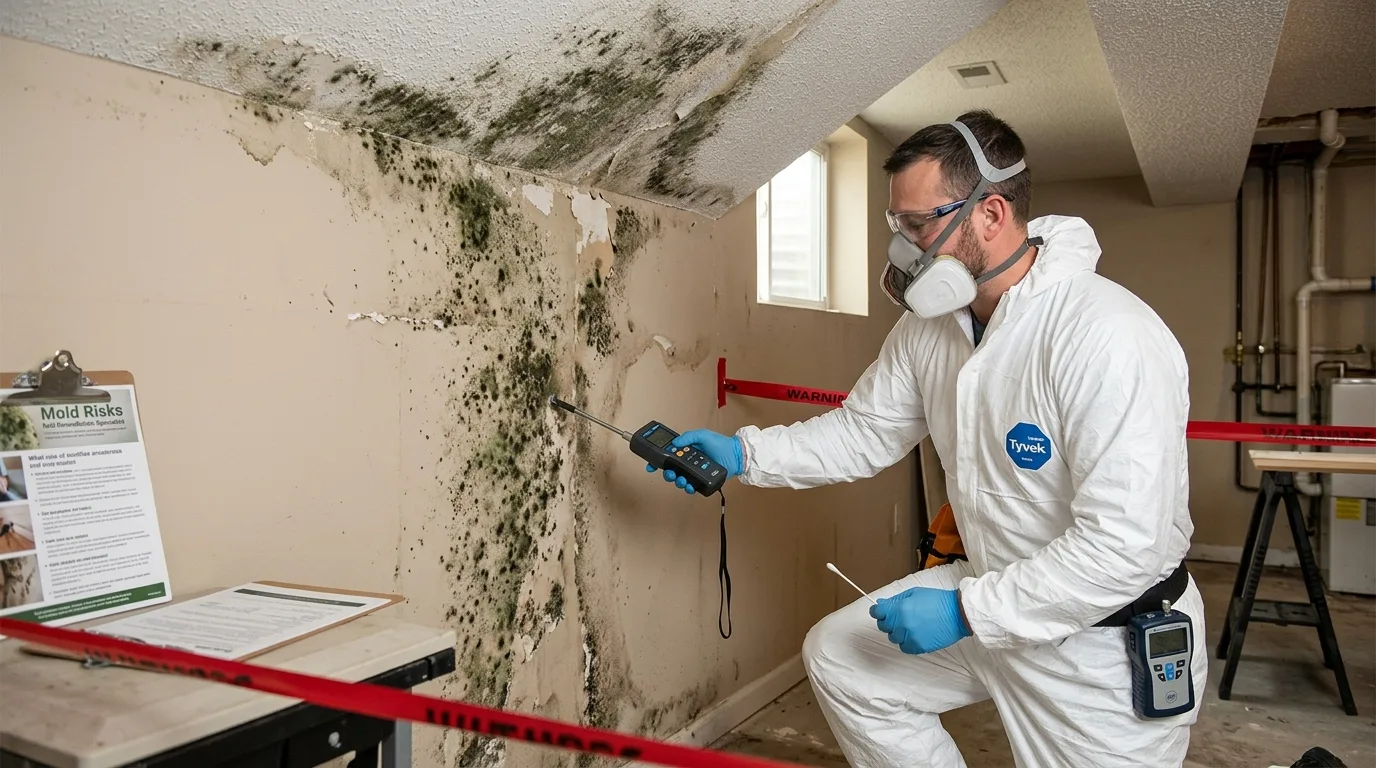
Professional mold remediation following water damage in Scottdale follows the IICRC S520 standard: inspection and air sampling to map the extent of contamination; containment with negative air pressure to prevent spore migration during removal; removal of affected porous materials under controlled conditions; HEPA vacuuming and antimicrobial treatment of structural surfaces; and post-remediation verification air sampling to confirm the remediation was successful.
The containment phase is critical in Scottdale’s climate because disturbing mold colonies in a high-humidity environment releases massive numbers of spores that can rapidly colonize new areas if containment fails. Negative air pressure containment — where air is drawn through HEPA filters out of the work zone rather than allowed to migrate into the home — is a non-negotiable element of professional remediation that DIY approaches cannot replicate.
Mold Spreading in Your Scottdale Home?
Containment first, then professional removal. Call (877) 698-1311 — we start the assessment today.
Cost Factors for Mold Remediation in Scottdale
Mold remediation in the Atlanta metro area typically ranges from $2,664 to $8,437, with crawlspace remediation in DeKalb County tending toward the higher end due to the additional dehumidification required to address the clay soil moisture environment. The full water damage restoration project — including extraction, drying, mold remediation, and reconstruction — averages $8,546.
Cost factors that most influence the final estimate: total square footage of mold growth, the number of structural areas requiring opening for cavity access, whether HVAC ductwork requires treatment, and the extent of materials requiring removal and replacement. The single most effective cost-reduction strategy is responding to water damage within the first 24 hours, before mold colonization begins. A water event addressed immediately by professional water extraction and structural drying costs far less than the same event addressed three days later when mold remediation has become a requirement.
Frequently Asked Questions
How do I know if I have mold in my Scottdale crawlspace?
Common indicators include a musty odor from floor registers or the crawlspace access hatch, visible dark staining on crawlspace framing members, and floor areas above the crawlspace that feel soft or slightly springy. Annual crawlspace inspections with moisture meter readings are the proactive approach — particularly for Scottdale homes with original crawlspace construction where clay soil moisture is the persistent baseline risk. See our crawlspace drying guide for Scottdale homeowners for inspection and prevention details.
Can I remediate mold myself in my DeKalb County home?
Small surface mold areas (less than 10 square feet) on non-porous surfaces — tile, glass, metal — can be addressed with appropriate protective equipment and EPA-registered antimicrobial cleaners. Mold inside wall cavities, on drywall facing, in subfloor materials, or in crawlspaces requires professional remediation. The containment requirements, HEPA equipment, and post-remediation verification are not replicable with consumer equipment. Attempting to remediate mold inside wall cavities without containment typically spreads the mold colony rather than eliminating it.
How does Scottdale’s red clay soil increase mold risk in my crawlspace?
The Piedmont red clay soil throughout DeKalb County retains moisture against crawlspace foundations for days after rainfall, maintaining relative humidity in the crawlspace well above the 70% threshold at which mold growth accelerates. This creates a baseline mold risk in any Scottdale crawlspace without a modern vapor barrier or encapsulation system — regardless of whether a discrete water event has occurred. Read more about this connection in our guide to red clay soil and water damage in Scottdale.
IICRC-Certified Mold Remediation in Scottdale
Post-remediation air testing included. Call Scottdale Water Damage at (877) 698-1311.
Related: