Why Scottdale's Red Clay Soil Makes Water Damage Worse
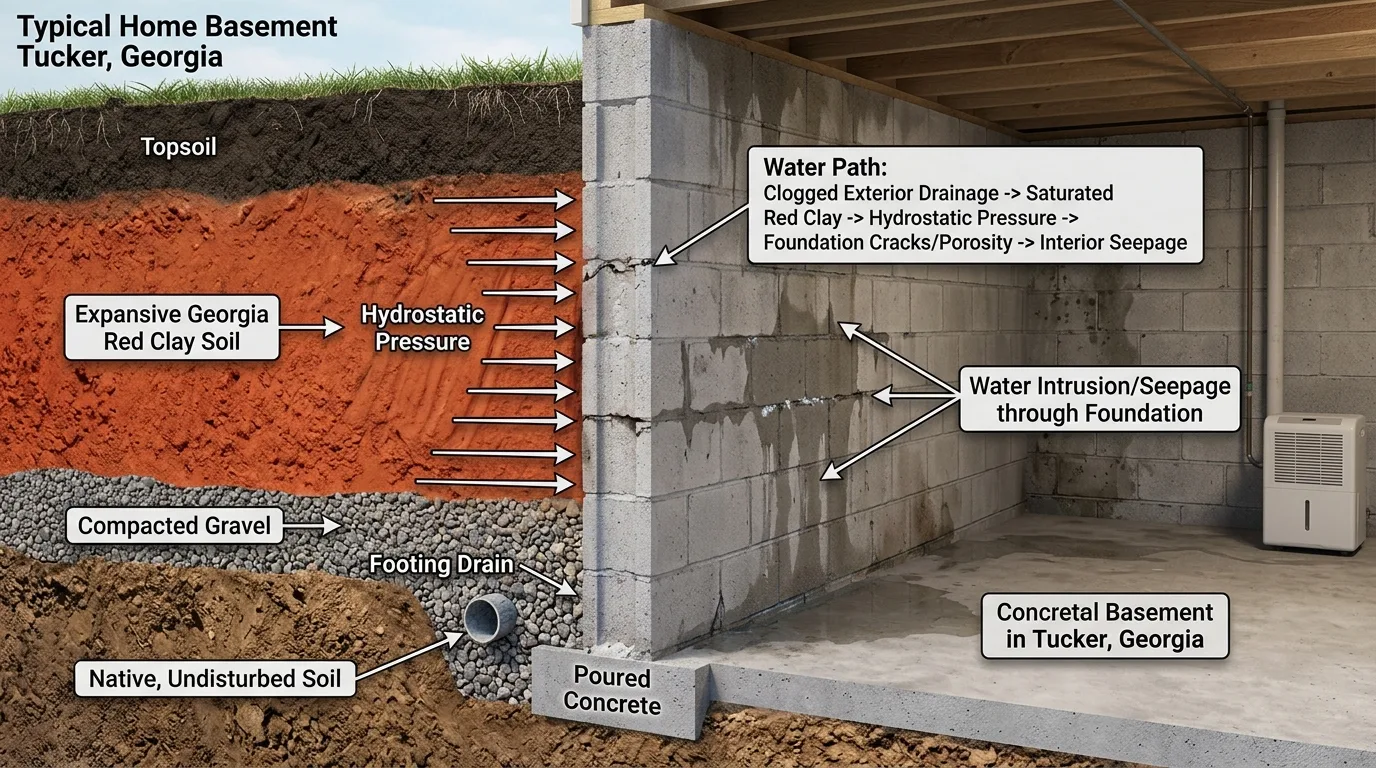
What if the ground beneath your Scottdale home was actively working against you every time it rained? That’s the reality for homeowners across DeKalb County — and understanding why changes how you think about water damage prevention and response.
In this post, we cover what makes Piedmont red clay soil different from other soil types, how it compounds water damage from plumbing failures and storm events, the specific risk it creates for crawlspaces, and what Scottdale homeowners can do to mitigate the long-term moisture pressure it creates.
Water Damage in Scottdale? Get Expert Help Now.
Our team understands DeKalb County's clay soil challenges. Call (877) 698-1311 for a free assessment.
Why Scottdale’s Red Clay Soil Matters for Water Damage
Scottdale sits in Georgia’s Piedmont region, where the dominant soil type is a dense, reddish clay derived from the weathering of ancient metamorphic rock. Unlike sandy coastal soils that drain quickly and release moisture within hours of rainfall, this Piedmont clay behaves more like a sponge — absorbing water slowly and releasing it even more slowly. After a significant rainfall event, the clay soil surrounding a Scottdale foundation can remain saturated for several days, maintaining constant hydrostatic pressure against basement walls, crawlspace foundations, and slab edges throughout that period.
This characteristic is what makes water damage in DeKalb County fundamentally different from water damage in, say, coastal Decatur communities on the Sandy Springs side of the metro area. When a pipe bursts or a storm sends water into a Lantern Ridge home, the damage isn’t just from the water that entered the structure — it’s compounded by the soil moisture that surrounds the foundation and keeps the ambient humidity inside the crawlspace or basement elevated for days afterward, dramatically slowing the natural drying process.
Types / Options: How Clay Soil Affects Different Water Damage Scenarios
Pipe burst scenarios: When a supply line bursts inside a Scottdale home, the water extraction and structural drying process is already more demanding than in a drier-soil region. The saturated clay outside the foundation creates a humidity reservoir that competes directly with the dehumidification equipment, extending drying timelines and requiring more aggressive equipment placements.
Storm flooding: Spring thunderstorms that overwhelm Scottdale’s storm drainage push water toward foundations from the outside — and clay soil that is already saturated from previous rainfall offers essentially no buffer capacity. The water table rises rapidly during multi-day rain events, and the clay keeps it elevated for days after the storm passes.
Crawlspace moisture accumulation: This is the most insidious scenario. Even without a discrete flood event, the red clay soil beneath and around a Scottdale crawlspace maintains sufficient moisture year-round to keep crawlspace relative humidity above 70% during warm months — the threshold at which mold growth accelerates significantly. Homes in the historic Scottdale Mills Village district and throughout the Tobie Grant community, where crawlspace encapsulation may be absent or degraded, are particularly vulnerable to this chronic moisture accumulation.
Practical Uses: What This Means for Your Restoration Project
- Extended drying timelines: Expect structural drying in Scottdale to take longer than the national average for equivalent events — the clay soil’s moisture reservoir actively works against the drying equipment. Budget for 5 to 10 days of drying rather than the 3 to 5 days that might be sufficient in other markets.
- Crawlspace inspections: Any Scottdale homeowner with a crawlspace foundation should have an annual moisture inspection — not just after water events. The clay soil creates chronic moisture conditions that may produce mold without any identifiable discrete event.
- Vapor barrier assessment: Existing vapor barriers in older Scottdale homes may be insufficient for the moisture pressure created by the local clay soil. A full 20-mil encapsulation system is significantly more effective than the thin plastic sheeting commonly installed in homes built before 2000.
- Foundation drainage: French drain systems and grading corrections that redirect water away from foundations before it saturates the surrounding clay are the most effective long-term mitigation for clay soil water pressure. These are particularly valuable for homes near the lower-lying areas around Stone Mountain Freeway.
- Insurance documentation: When filing a water damage claim in DeKalb County, documenting the soil moisture conditions as a contributing factor can support a more complete claim. Professional moisture mapping that shows soil-related ambient humidity levels provides context for extended drying timelines that insurers might otherwise question.
How Clay Soil Interacts With Scottdale’s Climate
Scottdale’s humid subtropical climate (Köppen Cfa) means that even without the clay soil factor, water damage restoration is more demanding here than in arid regions. Average annual rainfall exceeds 53 inches, distributed throughout the year with peaks in March through May (spring storm season) and July through August (convective thunderstorm season). The hottest month, July, averages a high of 89°F with humidity that routinely keeps the heat index above 95°F — conditions that severely restrict natural drying in unventilated spaces.
When clay soil moisture and ambient climate humidity combine, the resulting moisture environment inside a Scottdale crawlspace or flooded basement can be extraordinarily challenging to remediate. Consumer-grade fans and dehumidifiers simply do not have the processing capacity to overcome the combined moisture load. Industrial equipment — commercial dehumidifiers rated for 100+ pints per day per unit, paired with high-CFM air movers — is the minimum necessary to make meaningful progress against the moisture environment that Scottdale’s specific conditions create.
The best conditions for structural drying in Scottdale are late spring (May–June) and early fall (September–October), when temperatures are moderate and humidity drops from summer peaks. A water event that occurs at the height of summer — when ambient humidity is at its highest and the clay soil is maintaining maximum moisture content — requires the most aggressive drying approach and the longest timelines.
Clay Soil Water Damage Requires a Local Expert
We understand DeKalb County's soil conditions and calibrate our drying equipment accordingly. Call (877) 698-1311.
Cost Factors Related to Clay Soil
Water damage restoration in the Atlanta metro area averages $8,546, with a typical range of $1,874 to $15,960. For Scottdale homeowners, the clay soil factor affects cost primarily through extended drying timelines — each additional day of equipment rental and monitoring adds to the project total. It also affects crawlspace remediation costs, where the persistent moisture environment often requires more comprehensive treatment than comparable events in other soil types.
Investing in prevention — crawlspace encapsulation, foundation drainage, grading corrections — costs far less than repeated remediation. A comprehensive crawlspace encapsulation in a Scottdale home typically runs $3,000 to $8,000 depending on crawlspace size and condition; a single mold remediation event triggered by chronic clay soil moisture runs $2,664 to $8,437. The math favors prevention for any Scottdale homeowner who plans to remain in the property for more than a few years.
Frequently Asked Questions
Does clay soil cause foundation damage in Scottdale homes?
Yes — expansive Piedmont clay swells when wet and shrinks when dry, creating cyclical movement that can crack foundation walls and shift slabs over time. This movement is most pronounced in homes where the clay surrounding the foundation alternates between saturation during wet periods and drying out during drought conditions. Water damage from plumbing failures or storm events accelerates this cycle. See our crawlspace drying guide for Scottdale homeowners for mitigation strategies.
How do I know if my crawlspace has a moisture problem from clay soil?
Signs include a musty odor emanating from floor vents, visible mold or efflorescence (white mineral deposits) on crawlspace walls, sagging or soft areas in the floor above the crawlspace, and higher-than-expected summer utility bills from the HVAC working harder to dehumidify the home. A professional crawlspace inspection with moisture meter readings is the definitive assessment. Our team serves Scottdale and throughout DeKalb County for these assessments.
Can I fix clay soil moisture problems myself?
Surface-level grading corrections — sloping soil away from the foundation at a 6-inch drop over 10 feet — are a DIY-accessible improvement that helps reduce water infiltration. Full crawlspace encapsulation and French drain installation require professional equipment and expertise to be effective. Attempting to install vapor barriers in a Scottdale crawlspace without addressing the source of moisture intrusion first simply traps the problem rather than solving it. Read more about the full solution in our basement waterproofing vs. water damage restoration guide.
Scottdale Water Damage — Local Experts for Local Conditions
Don't let clay soil moisture become a mold problem. Call (877) 698-1311 for a crawlspace moisture assessment.
Related: