Emergency Water Extraction Scottdale GA: What to Expect
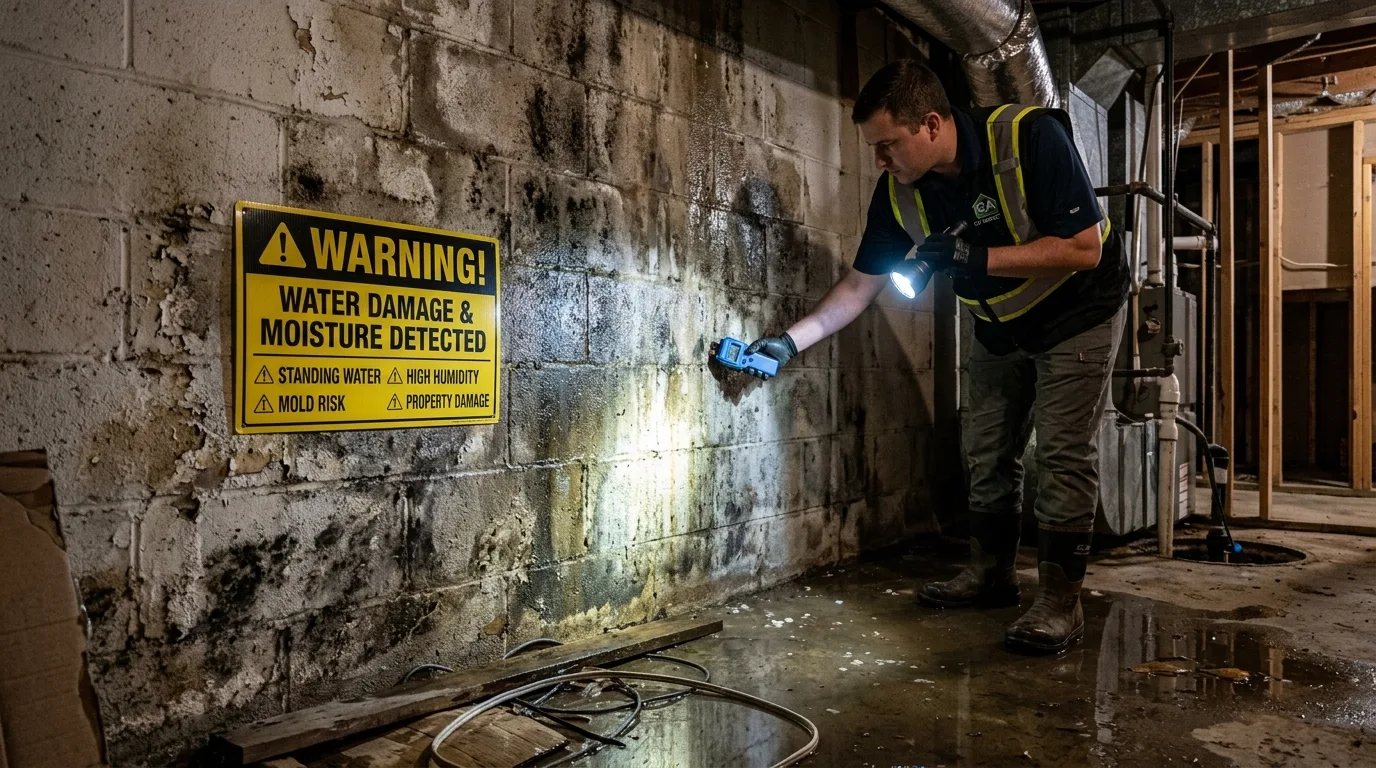
When you call a 24/7 emergency water extraction service for your Scottdale home, you’re making a decision under stress — often while watching water spread across your floors. Knowing exactly what to expect from the moment the phone rings through the completion of the drying phase turns a chaotic emergency into a managed process. This guide gives you that roadmap.
In this post, we cover what happens at each stage of emergency water extraction, how dispatch and response work in the Scottdale area, what equipment arrives and why, how moisture measurement guides the process, and when extraction transitions into the full water damage restoration sequence.
Emergency Water Extraction in Scottdale — We're Ready.
24/7 dispatch to all Scottdale and DeKalb County addresses. Call (877) 698-1311 now.
Why Speed Defines the Outcome for Scottdale Homeowners
The amount of damage your Scottdale home sustains after a water intrusion event is determined largely by how quickly extraction begins — not by the size of the original event. A burst pipe that is shut off within 15 minutes and extracted professionally within 2 hours may result in minimal structural damage. The same event with a 12-hour delay can require opening multiple wall cavities, replacing subfloor, and conducting mold remediation — all because water continued to travel laterally and vertically through the structure during the response window.
Scottdale’s humid subtropical climate compresses this timeline further. Late spring and summer conditions — when outdoor humidity exceeds 70% and indoor temperatures are elevated — create ideal conditions for mold colonization within 24 to 48 hours. A response initiated after that window has closed almost always includes mold remediation as part of the scope.
Types / Options: What Gets Extracted and How
Standing Water (Bulk Extraction): Truck-mounted extraction units are the primary tool for large-volume standing water — flooded basements, significantly flooded rooms, or crawlspaces with substantial water accumulation. These units move 10 to 20 times the volume per hour of portable equipment and are the fastest way to remove the majority of accessible water in the first 30 to 60 minutes of extraction.
Carpet and Pad: Weighted extraction wands draw moisture from carpet and pad — a specialty tool that prevents oversaturation of the underlying subfloor by removing as much water as possible from the carpet system before a decision is made about whether the carpet can be saved or must be removed. Carpet pad almost always requires removal after significant water exposure; carpet can sometimes be dried in place for Category 1 events addressed within hours.
Hard Flooring Surfaces: Squeegee extraction tools designed for tile, hardwood, and LVP remove surface water without damaging the flooring. However, water beneath hard flooring — in the subfloor layer — requires structural drying equipment to address after surface extraction is complete.
Wall Cavities: After surface extraction, pinless moisture meters identify water inside wall cavities. When saturation is significant, wall base sections are removed and cavity extraction tools direct airflow into the void to begin the drying process. This “flood cut” — removing the bottom 12 to 24 inches of drywall — gives access for both inspection and drying equipment.
Practical Uses: The Emergency Response Timeline Step by Step
- Call received and dispatch initiated (0:00–0:15): You call (877) 698-1311. The technician on call confirms your address in Scottdale, asks about the source and approximate volume of water, and initiates dispatch. Estimated arrival is communicated. Scottdale addresses are typically reachable within 45 to 75 minutes depending on the time of day.
- On-site inspection and scope assessment (arrival + 0:15–0:30): Thermal imaging and moisture meters map the full extent of water travel — including hidden moisture in walls and floors. The water category is determined. You receive a verbal summary of findings and an explanation of the work scope before any equipment is deployed.
- Bulk extraction (0:30–2:00): Truck-mounted extraction removes standing water. Specialty tools address carpet, hard floors, and any accessible cavities. By the end of this phase, all visible water has been removed.
- Equipment placement (2:00–2:30): Air movers and dehumidifiers are placed based on the moisture map — not just where water was visible. Each unit is positioned for maximum drying efficiency given the room geometry and the location of saturation.
- Daily monitoring (Day 2 through completion): A technician returns daily to take moisture readings at fixed monitoring points, document the drying progress, and adjust equipment placement as materials dry. You receive a copy of each day’s readings.
- Final verification and equipment pickup (Day 4–10): When all monitored points reach IICRC dry targets, final readings are documented in a written report. Equipment is removed. If reconstruction is required, that scope is provided separately.
How It Works: Transitioning From Extraction to Full Restoration
Emergency water extraction is the first phase of a larger water damage restoration sequence. After extraction and structural drying are complete, the scope of remaining work is determined: if all materials dried successfully and no mold developed, reconstruction of removed materials (flood cuts, removed carpet, etc.) is the next step. If moisture readings indicate that certain materials did not reach dry targets despite extended drying, those materials are removed before reconstruction.
If mold is identified during the drying phase — either through visual observation or air sampling — remediation is added to the scope before reconstruction. In Scottdale homes where the event involved crawlspace flooding, a separate crawlspace inspection and treatment may be required to address the clay soil moisture baseline that the flooding event elevated further.
What to Expect — No Surprises, Just Answers.
Scottdale Water Damage walks you through every step. Call (877) 698-1311 now.
Cost Factors for Emergency Water Extraction in Scottdale
Emergency water extraction in the Atlanta metro area typically runs $500 to $3,500 for the extraction phase alone, depending on volume and affected area. Across DeKalb County, the early-response cost is almost always less than the cost of delay — because every hour of delay adds to the total affected area and increases the probability that mold remediation becomes necessary.
The full water damage restoration project, including extraction, structural drying, and reconstruction, averages $8,546 in this market. Labor runs $155 to $444 per hour. Insurance documentation compiled during the extraction process — photographs, moisture readings, scope of work — supports the insurance claim and reduces your out-of-pocket cost when the event is covered. Most sudden and accidental pipe bursts and storm intrusions are covered under standard Georgia homeowner’s policies.
Frequently Asked Questions
How quickly can you respond to a water emergency in Scottdale, GA?
Our team can typically reach Scottdale addresses within 45 to 75 minutes of your call, depending on time of day and current dispatch volume. We maintain response capability 24 hours a day, 7 days a week including holidays. We also serve Decatur, Clarkston, Tucker, Stone Mountain, and all of DeKalb County with the same response commitment.
Should I try to extract water myself before the professionals arrive?
You can use towels to absorb small amounts of surface water on hard floors, but do not use consumer wet-vacs as your primary extraction strategy for significant flooding — they process water too slowly to prevent continued lateral spread, and they do not address moisture in structural materials at all. The most valuable thing you can do while waiting for professional extraction is shut off the water source, document with photographs, and ensure electrical safety (shut off the panel if water is near electrical outlets or the panel itself). See our burst pipe emergency guide for Scottdale homeowners for the complete first-response protocol.
What happens if I wait until morning to call for water extraction?
Waiting overnight — even 6 to 8 hours — allows water to travel significantly further into structural materials and dramatically increases the probability of mold development beginning in Scottdale’s humid climate. Events that would have been Category 1 clean-water-only remediation with immediate response frequently become mold remediation events after an overnight delay. The cost difference between a same-day response and a next-morning response is often $3,000 to $8,000 or more. For the full context of what that timeline means, see our complete guide to water damage restoration in Scottdale.
Scottdale Water Damage — 24/7 Emergency Response
Don't wait until morning. Call (877) 698-1311 right now — we're ready to dispatch.
Related: