Spring Storm Season in DeKalb County: Flood Prevention Guide
Georgia’s tornado and severe thunderstorm season produces more water damage insurance claims in DeKalb County during March, April, and May than any other three-month period of the year. Annual precipitation in Scottdale exceeds 53 inches — and a disproportionate share of that total falls during intense spring storm events that can deposit two to four inches of rain in a single afternoon, overwhelming residential drainage infrastructure that was designed for more moderate conditions.
In this post, we cover the specific flood risks that spring storms create for Scottdale and DeKalb County homeowners, practical prevention steps you can take before storm season arrives, what to do immediately after a flood event, and when professional flood cleanup is necessary.
Storm Flooding Hit Your Scottdale Property?
24/7 emergency flood cleanup — call (877) 698-1311 for immediate dispatch.
Why Spring Storms Pose a Unique Flood Risk in DeKalb County
Spring flooding in DeKalb County is shaped by the intersection of three factors that amplify each other’s effects. First, Scottdale’s position in the Georgia Piedmont means its surrounding topography channels storm runoff toward lower-lying residential areas, particularly near the Stone Mountain Freeway (US 78) corridor and the I-285 interchange, where grade changes concentrate water flow during heavy events.
Second, the Piedmont red clay soil throughout DeKalb County reaches peak saturation during the wet spring months — after winter rainfall has already reduced the soil’s absorption capacity. By mid-March, the soil around many Scottdale foundations is already at or near saturation, meaning spring storm runoff has nowhere to go except toward foundations, through window wells, and down drainage paths that lead into crawlspaces and basements.
Third, Georgia’s peak tornado season — March through May — produces not just heavy rain but structural damage that creates new water entry points: wind-lifted shingles, broken gutters, dislodged vent covers, and cracked foundation walls that become immediate flooding pathways during the same storm that caused the structural damage.
Types / Options: Spring Flood Risks by Property Type
Crawlspace Foundation Homes: The most vulnerable structure type in Scottdale during spring storm events. Crawlspace flood damage occurs when surface runoff overwhelms foundation vents, when the water table rises above the crawlspace floor grade, or when gutters and downspouts deposit water at the foundation instead of directing it away. The resulting water extraction and crawlspace drying process can take 7 to 14 days in DeKalb County’s clay soil environment.
Slab-on-Grade Homes: Lower flood risk for the structural floor system, but still vulnerable to water intrusion at door thresholds, garage door seals, and window wells during heavy rainfall. Slab homes frequently sustain water damage to baseboards, drywall, and flooring from lateral water intrusion during spring storms.
Homes with Basements: Relatively uncommon in the Scottdale area but present in older sections of the community. Basement flooding during spring storms can involve significant water volume and may require Category 2 or 3 flood cleanup if stormwater carries contamination into the space.
Historic Mill Village Structures: Homes in the Scottdale Mills Village area, built between 1900 and 1915, often have original drainage infrastructure that was not designed for modern rainfall intensity patterns. Deteriorated gutter systems, compromised foundation waterproofing, and original-grade crawlspace foundations make these properties particularly vulnerable to spring flooding.
Practical Uses: Pre-Storm Prevention Steps for Scottdale Homeowners
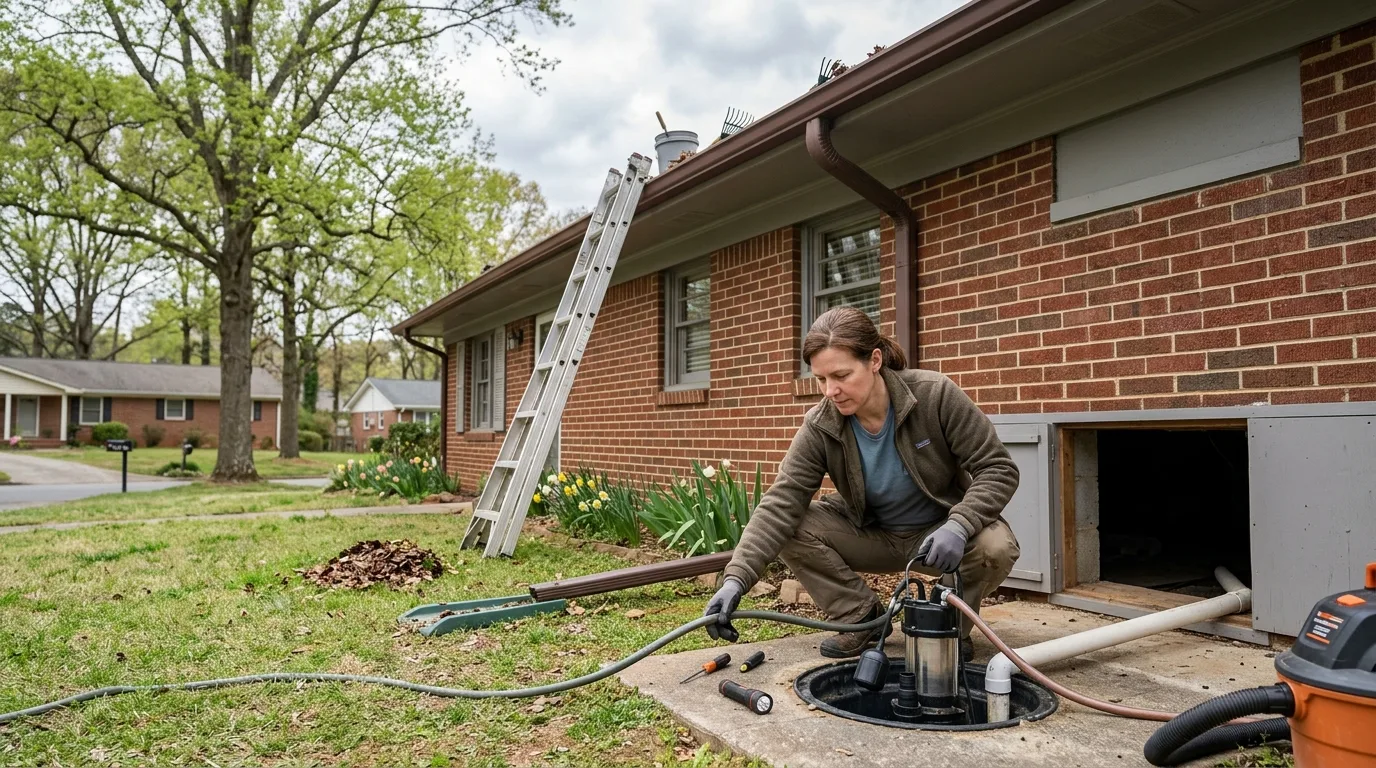
- Clean gutters and downspouts in February: Leaf and debris accumulation from fall and winter causes gutters to overflow during heavy spring rain, depositing water at the foundation rather than directing it away. Clean gutters are the single most cost-effective flood prevention measure available to any Scottdale homeowner.
- Inspect and extend downspout extensions: Downspouts should deposit water at least 6 feet from the foundation and discharge onto ground that slopes away from the structure. Extensions that terminate too close to the foundation or uphill of it direct water toward the crawlspace or basement during heavy rainfall.
- Grade soil away from the foundation: The soil immediately surrounding your foundation should slope away at a minimum of 6 inches of drop over 10 feet. Clay soil that has settled against the foundation acts as a water channel directing runoff toward foundation walls.
- Check foundation vents: Crawlspace foundation vents should be in good condition, with intact screens. During extreme flooding events, temporary vent flood covers can reduce water intrusion.
- Test sump pump operation: If your property has a sump pump, test it before spring storm season by pouring water into the pit. A sump pump that fails during a spring storm flood can result in a Category 2 event that would have been prevented by a $20 test and a battery backup installation.
- Inspect attic ventilation and roof penetrations: Spring tornado activity can compromise roof integrity instantly. Knowing the condition of your roof before storm season allows you to address vulnerabilities before they become water damage events during the next heavy rain.
How It Works: What Happens After a Spring Storm Flood
Flood damage cleanup after a DeKalb County spring storm event follows the IICRC S500 process: water category assessment, extraction, materials removal, dehumidification, and structural drying. The specific protocol depends on whether the flood involved clean rainwater (Category 1), stormwater that contacted surfaces (Category 2), or stormwater combined with sewage or other contamination (Category 3).
Spring storm floods frequently escalate to Category 2 or 3 when municipal storm drain systems — which are shared with sanitary sewer infrastructure in some older DeKalb County systems — become overwhelmed and force sewage into homes through floor drains. This is one of the most commonly underestimated flood risks in Scottdale neighborhoods served by older municipal infrastructure.
Spring Storm Damage in Scottdale? Act Immediately.
Category 2 and 3 flood water is a health hazard — call (877) 698-1311 for safe same-day cleanup.
Cost Factors for Spring Flood Cleanup in Scottdale
Atlanta metro flood damage cleanup costs range from $1,874 to $15,960 for most residential events, averaging $8,546. Spring storm flooding in DeKalb County tends toward the higher end of this range when the clay soil environment extends drying timelines and when storm sewage contamination elevates the event to Category 3. Category 3 cleanup costs reach approximately $16.65 per square foot, compared to $7.77 for clean water events.
The most significant cost reduction strategy is speed of response. Emergency water extraction initiated within the first 2 hours of flooding prevents the lateral spread of water into additional rooms and walls, and gives the dehumidification equipment the best possible starting conditions. Every hour of delay allows water to travel further and saturate more material.
Standard homeowner’s insurance typically covers sudden storm flooding caused by roof damage or structural intrusion — but not rising groundwater flood events, which require separate flood insurance. If your property flooded during a spring thunderstorm through a roof or structural breach, file your claim immediately and contact a professional contractor for documentation support.
Frequently Asked Questions
What should I do immediately after my Scottdale home floods from a spring storm?
Stop entering flooded areas until you verify the electrical panel has been shut off — water and active circuits are a life safety issue. Once safe, document everything with photographs before any cleanup begins. Call your insurance company to report the claim. Call a 24/7 water extraction service — do not attempt to extract the water with a wet-vac alone for significant flooding, as this slows response and increases damage. The full emergency response process is covered in our emergency water extraction guide for Scottdale.
Does homeowner’s insurance cover spring storm flooding in DeKalb County?
Storm damage to your roof or structure that allows rainwater to enter is generally covered under standard homeowner’s policies in Georgia. Rising groundwater — water that enters from the ground level up due to the water table rising — requires separate flood insurance. Review your policy or call your agent to clarify which scenarios are covered before storm season. Our DeKalb County insurance claim guide covers the full filing process.
How do I know if my spring storm flood involved sewage contamination?
Sewage contamination is indicated by a sewage odor, visible solids in the floodwater, discoloration inconsistent with clean rainwater, or flooding that entered through floor drains or toilets. If any of these indicators are present, treat the event as Category 3 — do not allow occupants to be in the flooded space, wear appropriate protective equipment if you must enter, and call a professional immediately. Category 3 cleanup requires controlled disposal of all porous materials and thorough antimicrobial decontamination.
Prepare Before the Next Storm Hits
Scottdale Water Damage is available 24/7 for spring storm emergencies. Call (877) 698-1311 to get started.
Related: